Procurement teams lose money on piling equipment the same way every time: they spec the machine before they spec the job. A unit that drives posts beautifully on graded farmland will bog down on a sloped, ungraded parcel, and a rig matched to rock is dead weight on soft soil. The fix is a disciplined checklist — ground conditions, pile specification, piling method, productivity, compliance, supplier capability, total cost of ownership, and logistics — locked down in that order. This guide breaks the buying decision into 10 checkable factors, each with the typical specification numbers that actually drive price and uptime, so you can qualify a solar piling equipment package against your site survey instead of a brochure. All figures below are typical ranges for utility-scale PV foundation work; final selection should follow a geotechnical report.
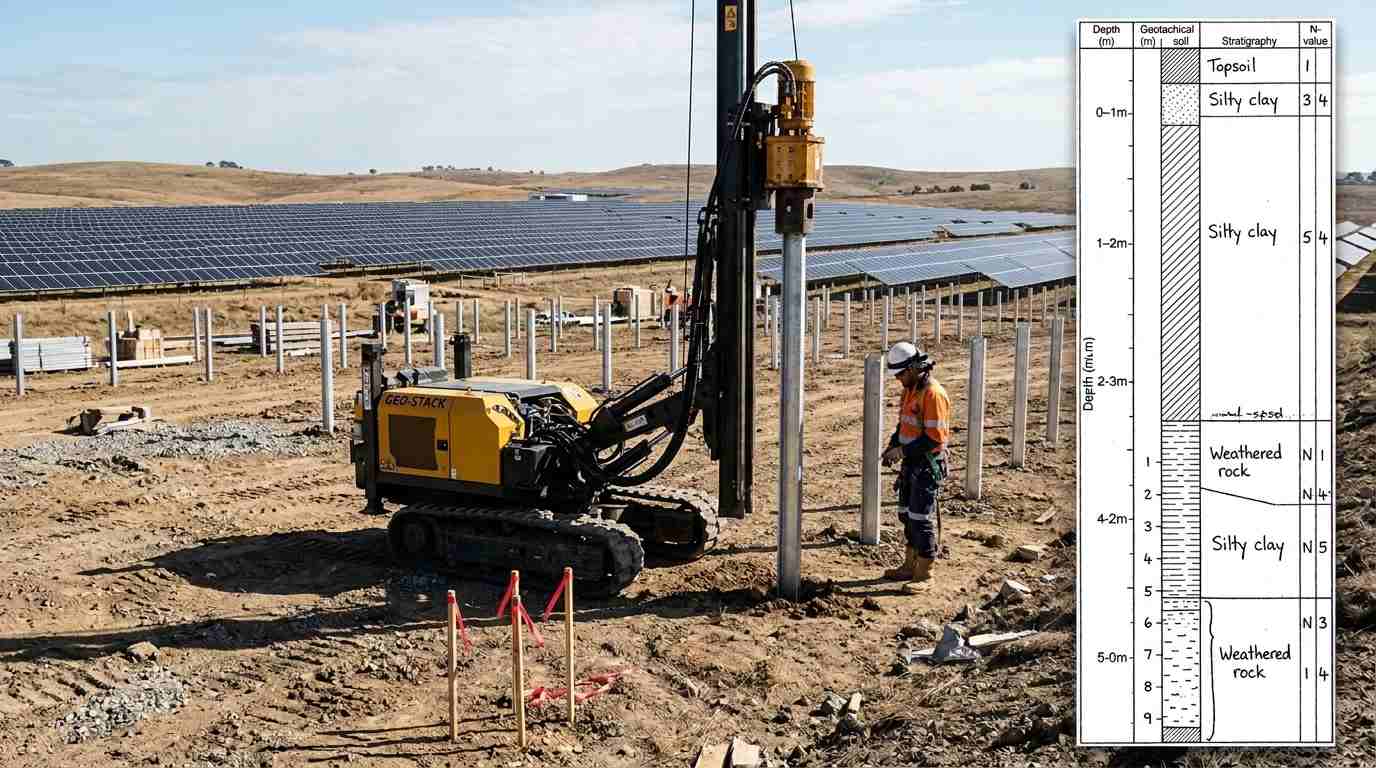
Before ordering a piling machine, check 10 factors in three groups. Site & soil (factors 1–3): ground bearing capacity (soft soil under 40 kPa vs. rock above 300 kPa), pile spec (typical PV steel posts 76–114 mm diameter, 1.5–3.5 m embedment), and site access. Machine specs (factors 4–6): piling method matched to soil (ram for soft ground, DTH for rock, auger for cohesive soil), core specs (ram impact energy typically 8–25 kJ, down-force 60–150 kN), and output (60–120 posts/day on soft soil, 8–20/day in rock). Commercial & supply (factors 7–10): CE and ISO9001 certification, a direct factory with OEM capability, total cost of ownership (fuel typically 6–12 L/h), and logistics (8–15 t machine, 30–60 day lead time).
Rule of thumb: soil and pile spec decide the machine class; everything else decides the price. Never let a quotation lead the specification.
|
664 GW
Global PV installations in 2025
|
~70%
Share of piling-machine demand from utility-scale projects
|
~60%
Share of hydraulic piling units in new fleet sales
|
30–60 days
Typical factory lead time, ex-works to port
|
The 10-Factor Checklist at a Glance
Use this table as the front page of your procurement file. Each row is a decision gate: if you cannot fill the "typical benchmark" column with data from your own site survey, the specification is not ready to send to suppliers. The factors are ordered deliberately — a mistake in factors 1–3 invalidates every number below it.
| # | Factor | Why it decides the purchase | Typical benchmark |
|---|---|---|---|
| 1 | Ground bearing capacity | Sets chassis type and ground pressure limit | Soft soil <40 kPa; farmland 60–120 kPa; rock >300 kPa |
| 2 | Pile specification | Post diameter and embedment set impact energy | 76–114 mm posts; 1.5–3.5 m embedment |
| 3 | Site access & slope | Decides crawler vs. wheeled and trailer plan | Wheeled to ~8° slope; crawler to ~15–20° |
| 4 | Piling method vs. soil | Wrong method = zero productivity, not just low | Ram = soft soil; DTH = rock; auger = cohesive soil |
| 5 | Core machine specs | Energy and force must cover worst soil layer | Ram 8–25 kJ; down-force 60–150 kN; 60–120 kW power |
| 6 | Productivity | Cost per post is the real price metric | 60–120 posts/day soft soil; 8–20/day in rock |
| 7 | Certification & compliance | CE is mandatory for EU; ISO9001 de-risks quality | CE + ISO9001; noise limits per destination rules |
| 8 | Manufacturer capability | Direct factory + OEM avoids trader markup and delays | Own plant, 10+ years export record, OEM scope |
| 9 | Total cost of ownership | Fuel, spares, and labor dwarf the purchase price gap | Fuel 6–12 L/h; spares kit 3–5% of unit price |
| 10 | Logistics & terms | Freight and lead time can move the budget 10–15% | 8–15 t machine; 40′ HQ or flat rack; 30–60 days |
Site & Soil: Factors 1–3
Factor 1 — Ground bearing capacity
Ground bearing capacity, reported in kPa from borehole or plate-load tests, decides whether a crawler chassis (typical ground pressure 35–55 kPa) can operate at all. Soft soil under 40 kPa and recently backfilled ground are the two conditions that strand tire-based units within the first hour of a shift. Ask for the geotechnical report before comparing quotations; if none exists, a tracked chassis is the default choice because it degrades gracefully on unknown ground.
Factor 2 — Pile specification
Post diameter, wall thickness, and embedment depth set the required impact energy. Utility-scale PV steel posts typically run 76–114 mm in diameter with 3–6 mm wall thickness, driven 1.5–3.5 m into the ground. Heavier sections or deeper embedment push the requirement toward the top of the 8–25 kJ ram range — or toward a DTH rig when the post is grouted into pre-drilled rock sockets. Freeze depth and corrosion allowance in desert or coastal sites add another 0.3–0.8 m of embedment, so specify for the worst layer, not the average.
Factor 3 — Site access and slope
Access decides the chassis class and the transport plan. Wheeled units handle firm, graded parcels and transfer between sections at 20–30 km/h, which matters on large uniform sites; crawlers hold traction on slopes up to roughly 15–20° where wheeled units stop at about 8°. Check gate widths, bridge load ratings, and turning radii before delivery — a 9-ton machine on a low-loader needs more margin than a spec sheet suggests.
Machine Specs: Factors 4–6
Factor 4 — Piling method matched to soil
The piling method must match the dominant soil layer, not the average one. Ram (impact) driving suits soft to medium soils; down-the-hole drilling cuts through rock where a ram cannot; augers handle cohesive, root-filled ground; and ground-screw systems work where no excavation spoil is permitted. Multi-function units that combine ram, DTH, and auger on one chassis remove the risk of a method mismatch mid-project — the reason 3-in-1 platforms are now standard on mixed-terrain solar farms.
| Soil / rock condition | Recommended method | Typical output |
|---|---|---|
| Soft soil, farmland, sand | Ram (impact) driving | 60–120 posts/day |
| Weathered rock, hardpan | Down-the-hole (DTH) drilling | 15–40 m per shift; 8–20 posts/day |
| Cohesive clay, roots | Auger drilling | 30–60 posts/day |
| Mixed terrain (part soil, part rock) | 3-in-1 ram + DTH + auger platform | Keeps the crew on one machine all season |
Factor 5 — Core machine specifications
Four numbers describe a piling unit's capability: impact energy in kJ for ram work, down-force in kN for pushing and holding, drilling diameter in mm and depth in m for DTH configurations, and installed power in kW. For PV post driving, typical packages sit at 8–25 kJ ram energy, 60–150 kN down-force, and 60–120 kW power packs. For DTH configurations on rocky sites, expect 90–152 mm bore capability and 5–30 m depth. Specify the mast height against your tallest pile plus leader margin, and check hydraulic flow and pressure ratings rather than just engine power.
Factor 6 — Productivity
Compare machines on posts per day and cost per post, not on unit price. A purpose-built piling platform is up to 60% faster per post than an excavator-mounted improvised rig, because cycle time — position, clamp, drive, release — is engineered into the machine. Soft-soil ram work typically delivers 60–120 posts per day per machine; rock drilling with DTH typically delivers 8–20. Multiply by crew shift hours and subtract repositioning time, then convert to cost per post including fuel and labor: that single number is the honest basis of comparison between two quotations.
Commercial & Supply: Factors 7–10
Factor 7 — Certification and compliance
CE marking is mandatory for placing machinery on the EU market, and ISO9001 certification is the baseline evidence that the factory runs a controlled quality system — both should be verifiable certificates, not logo claims. Beyond that, check destination-specific rules: noise limits near residential areas (many jurisdictions cap site noise below 85 dB), emissions stage requirements, and operator guarding standards. Non-compliant machines get held at customs or shut down on site, and the delay cost exceeds any price saving.
Factor 8 — Manufacturer capability
A direct factory with OEM capability prices lower than a trading company on identical specs and can still adapt the machine — mast length, chassis class, hammer size, paint and decals — to your project. When screening a piling-machine manufacturer or wholesale supplier, ask for the plant ownership evidence, years of export record, reference projects in your region, and the OEM scope in writing. Factories that build multiple product lines — for example a maker of solar piling equipment alongside highway guardrail post driver platforms and down-the-hole rigs — usually carry deeper hydraulics and drivetrain engineering than single-product assemblers.
Factor 9 — Total cost of ownership
Fuel, spares, and labor decide the real cost. Typical hydraulic piling units burn 6–12 L/h depending on load factor; over a 2,000-hour season that is a five-figure operating line. Budget a spares kit at 3–5% of unit price (hoses, seals, filters, clamp pads, hammer wear parts) and confirm the factory stocks wear parts for at least 10 years. Ask for the maintenance schedule and the hydraulic oil change interval in writing — machines with documented service intervals hold resale value far better than undocumented units.
Factor 10 — Logistics and commercial terms
A piling machine in the 8–15 t class typically ships in a 40′ HQ container or on a flat rack, and freight can move the landed budget by 10–15% depending on destination. Confirm ex-works lead time (typically 30–60 days from deposit for configured units), the inspection and acceptance procedure, spare-parts inclusion, and operator training. Payment structure matters too: a 30/70 deposit-balance against inspection photos and BL is common; avoid full prepayment from any supplier unwilling to document the factory test run.
Five Buying Mistakes That Show Up on Site
1. Buying on unit price alone. The cheapest quotation usually hides the smallest down-force, the thinnest mast, or a trader's margin — all three surface as downtime in week two.
2. Skipping the geotechnical report. Without bearing-capacity data, chassis and method selection is guesswork; the report costs a fraction of one wrong-machine return.
3. Ignoring the worst soil layer. Machines specified to the average soil stall on the first hardpan or rock lens — always spec to the worst layer on site.
4. No spares plan. A single unavailable hose or seal can idle a crew for days; order the wear-parts kit with the machine, not after the first failure.
5. Verbal compliance. "CE-compliant" in an email is not a certificate; request the actual CE and ISO9001 documents before the deposit clears.
What a Qualified Piling-Machine Supplier Looks Like
A supplier worth a deposit check demonstrates four things in writing: factory ownership and production capacity (not a rented showroom), certification documents (CE, ISO9001) that match the exact model offered, export references in your market with contactable projects, and an OEM scope covering chassis, mast, hammer, and hydraulics configuration. Ask for a machine test video on their own yard before shipment, and confirm the hydraulic and electrical components' brands — recognized pumps, valves, and motors are the difference between a machine that runs a season and one that runs a decade.
For buyers comparing options, the practical shortlist question is simple: can this manufacturer or OEM factory configure the machine to the site survey, prove compliance with documents, and support it after the container leaves the port? Suppliers who answer all three with specifics — lead times, spares stock, response commitments — are the ones whose machines show up in utility-scale PV projects year after year.
FAQ
How long does it take to get a piling machine delivered?
Typical ex-works lead time is 30–60 days for a configured unit from a direct factory, plus sea freight that varies by destination — commonly 20–45 days to European, Middle Eastern, or Southeast Asian ports. Machines built to a standard catalog configuration can sometimes ship faster; heavily customized OEM builds sit at the top of the range.
Is CE certification really necessary for a piling machine?
For the EU market, yes — CE marking is a legal requirement for placing machinery into service, and customs can hold non-certified equipment. Outside the EU, CE is not mandatory but remains useful evidence of a controlled quality system; pair it with ISO9001 certification and destination-specific noise and emissions rules when writing the purchase specification.
Should I buy a new or a used piling machine?
New units from a direct factory suit multi-season programs: full certification, warranty, and a spares plan. Used machines can make sense for a single short project, but verify hydraulic hours, weld and mast condition, and parts availability first — wear parts for discontinued models are the usual failure point, and total cost of ownership can exceed a new unit within two seasons.
How many piles can one machine drive per day?
On soft soil with ram driving, a purpose-built machine typically drives 60–120 posts per day; in weathered rock with down-the-hole drilling, expect 8–20 posts per day at 15–40 m of drilling per shift. Actual output depends on post spec, embedment depth, crew experience, and repositioning distance between rows — always benchmark candidates against posts per day and cost per post, not unit price.
Send us your geotechnical data, pile specification, and project scale, and our engineering team will recommend the chassis class, piling method, and machine configuration — with certification documents and a configured quotation in return.
Contact the TeZhong engineering team via tzpilemachine.com/about-us →